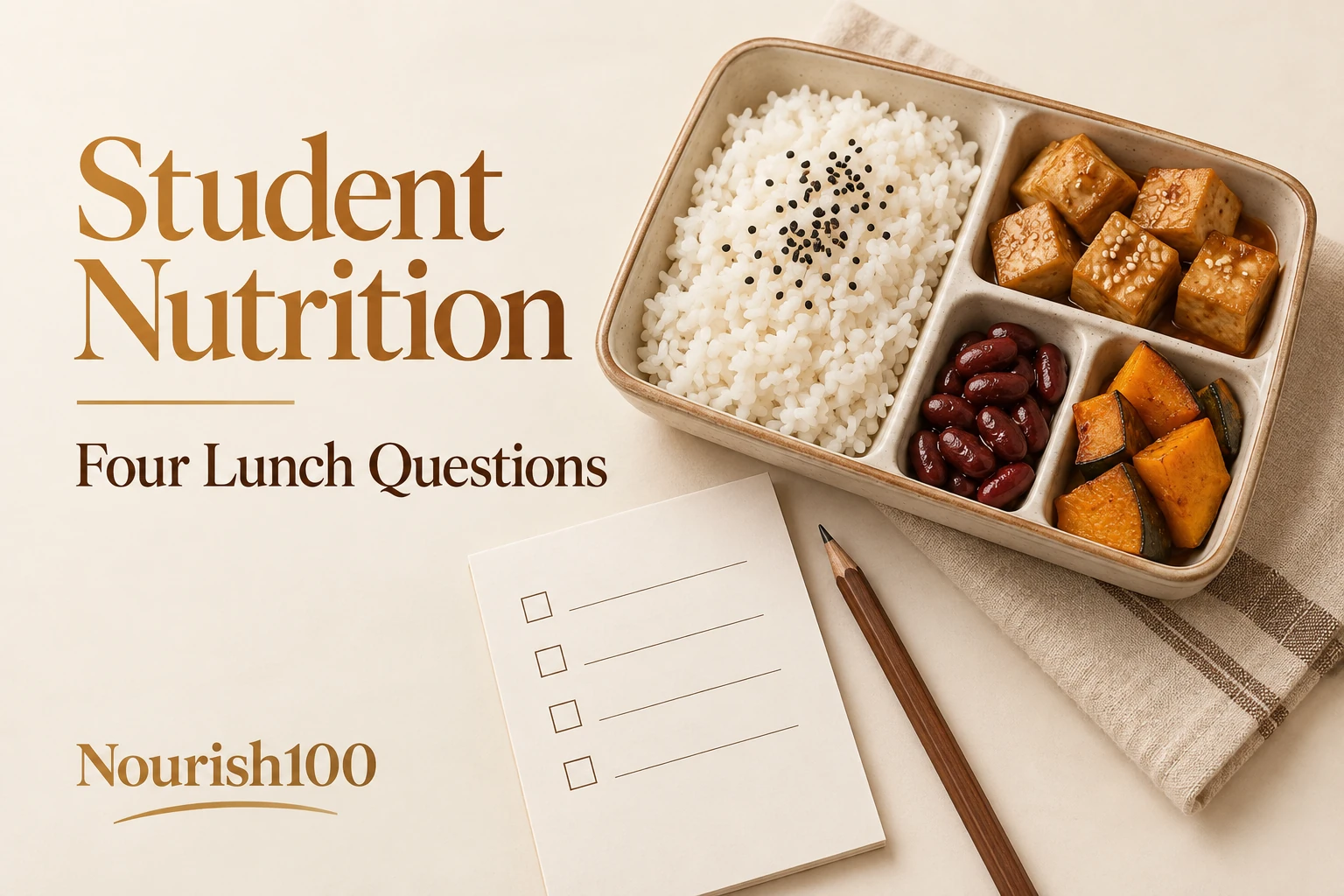
Ordering a vegetarian school lunch: four questions for families and schools
A vegetarian school lunch needs more discussion than a request to remove the meat. Use four questions to clarify ingredients, alternatives, fortified-food labels and a backup if the wrong meal arrives. The checklist supports communication; it cannot establish a student's overall nutritional adequacy.
Do not stop at writing “no meat” on the lunch order. Clarify whether the student eats eggs and dairy, then ask about the staple food, alternative components, portion choices and what happens if the selected meal is unavailable. An ordering checklist is a communication tool, not proof that a child's nutritional needs are met.
This article is for families of primary and secondary pupils and school lunch coordinators. Young children, pregnant teenagers and students with diagnosed nutritional deficiencies, food allergies or special treatment needs require individual professional advice; they should not use this as a prescribed menu.
Vegetarian lunch involves more than removing meat
Hong Kong's Student Health Service advises careful planning for vegetarian children and young people, including attention to protein, vitamin B12 and iron. This does not mean vegetarian eating inevitably causes a deficiency, or that finding tofu in a lunch box removes the need to consider the rest of the diet. Student Health Service: vegetarian diet and nutrition
Prepare a short list of acceptable ingredients, ingredients the family excludes and items needing clarification. Describe dietary choices separately from diagnosed food allergies. The label “special meal” alone does not explain each student's requirements.
Question one: what does this meal actually contain?
A menu name is not enough. Ask about ingredients and available alternatives: the components of “garden rice”, whether eggs or dairy are included, and whether sauces or stocks can be confirmed.
Explain the family's needs rather than asking the caterer to endorse a dietary philosophy. If the answer is not yet known, mark it as unconfirmed and choose an option that can be checked. Do not infer every ingredient from a vegetarian label.
Question two: what replaces the removed component?
Ask: “Apart from rice and vegetables, what replaces the meat in this meal?” Beans or tofu might be options; students who eat eggs or dairy can ask about those choices too. These are examples of an ordering conversation, not fixed portions or a nutritional prescription suitable for everyone.
Also ask whether the student likes the available food, has time to eat and can choose an appropriate portion. Delivery is not the same as eating. Repeated leftovers should prompt a discussion of taste, texture and lunchtime arrangements rather than a quick judgement that the child is fussy.
Question three: does the label confirm fortification?
Vegan families need to include vitamin B12 in overall dietary planning. The Student Health Service advises checking labels for added B12 and consulting a doctor when necessary before purchasing supplements. “Plant-based” is not a replacement for those checks. Student Health Service: vitamin B12 section
The NHS lists calcium-fortified plant drinks and calcium-set tofu among calcium sources. This supports checking the product and ingredients, not assuming every soya drink, oat drink or tofu sold in Hong Kong is equivalent. UK seasonal supplement recommendations are not being applied here. NHS: the vegan diet
If a drink is supplied at school, ask whether its original packaging information is available. Families can bring labels from usual foods to a qualified nutrition professional. This article does not give supplement doses, encourage children to buy them independently or promise that one fortified drink meets a whole day's needs.
Question four: what happens if the meal is missing or wrong?
Agree a contact person, a way to report a problem and a feasible backup before ordering. Which teacher should a student approach? Can the caterer supply a confirmed alternative? How will the family be told?
Do not leave the child to negotiate alone with the supplier, or make going without lunch the routine backup. If bringing food from home is an option, check the school's carrying, storage and eating arrangements separately. Do not assume any packed meal can wait until lunchtime without suitable facilities.
Put the four answers on one ordering note
Use four headings: acceptable ingredients, confirmed meals, unanswered questions and the contact or backup arrangement. Keep the note with the family and share it with the school's designated contact as needed, not in a class group chat containing a student's health or medication details.
For example, a student who avoids meat but eats eggs and dairy could try two meals the caterer has actually confirmed, then explain which they find acceptable. A vegan family would separately discuss B12 and whole-day nutrition with a qualified professional. This is an illustration, not a claim that a particular school already offers these options.
Next step: try one week and resolve one problem
There is no need to make the student score every lunch for healthiness. Over one week, ask whether the meal matched the order, whether any part was difficult to eat and whether help was available when something went wrong. Choose one practical obstacle to address.
If the choices remain inadequate, take actual menus and unresolved questions to the school and a nutrition professional. Do not rely on increasing supplements to fill every gap. For reading packaging, see comparing nutrition-label portions for students.
Reconfirm the checklist when menu items or the school's caterer change. Answers about an old menu cannot automatically be treated as guarantees about a new meal.
Frequently asked questions
1. Does a vegetarian label suit every vegetarian student?
Not automatically. Check whether ingredients such as eggs and dairy match the family's choices, and explain allergy requirements separately to the meal provider.
2. Can we simply order rice and vegetables?
Do not treat removing other components as a complete long-term plan. Ask about replacements, then seek advice based on the student's overall diet and growth needs.
3. Must we buy B12 supplements ourselves?
This article cannot decide for an individual student. Vegan families should plan reliable sources with qualified professional advice rather than trying doses found online.
4. Does the note certify that the meal is nutritionally adequate?
No. It records communication and meal arrangements. It is neither an individual nutrition assessment nor certification of a school or caterer.
Sources and health boundary
- Hong Kong Department of Health, Student Health Service: Vegetarian Diet and Nutrition. Revised June 2023.
- NHS: The vegan diet. Reviewed 5 June 2026. General food-planning principles only; UK-specific policy is not applied.
This article is for general health education only. It does not replace diagnosis, medication adjustments or personalised treatment. If you have symptoms, a long-term condition, are pregnant, take medication or have questions about changing your diet, consult a qualified healthcare or nutrition professional.
Ordering conversations and trial arrangements are editorial examples. No real student case, school adoption or measured impact is claimed.
Evidence and sources
References
- Vegetarian Diet and Nutrition — 香港衞生署學生健康服務 / Student Health Service
- The vegan diet — NHS
An update may change wording or layout and does not mean every source has been re-reviewed. Guidance may change with new evidence. Check each original source’s date and intended population. Ask a qualified professional about your individual health circumstances.