School Lunch Portions: What Changes from Lower Primary to Secondary School?
The 3:2:1 lunch ratio is easy to remember, but it does not mean giving every student the same-sized lunch box. Growth and activity needs differ across lower primary, upper primary and secondary school, alongside food choices, actual portions and individual health needs. Here is how families and schools can discuss proportions and portions without competing over who eats less.
The school lunch ratio of 3:2:1 refers to the volume of grains, vegetables, and meat, fish, eggs and alternatives in a lunch box. It is a guide to combining food groups, not a ratio of calories or a rule that every student must eat the same-sized box of food. Portions need to take account of age, growth, activity and health. Department of Health: Healthy Eating at School: Nutrition Workshop
This article is for parents of primary and secondary students, teachers, and secondary students who want to understand their lunches. It is not a guide to feeding young children, planning special medical diets or prescribing weight loss for children. Anyone with an eating plan from a doctor or dietitian should follow their individual advice.
First, separate proportions from portions
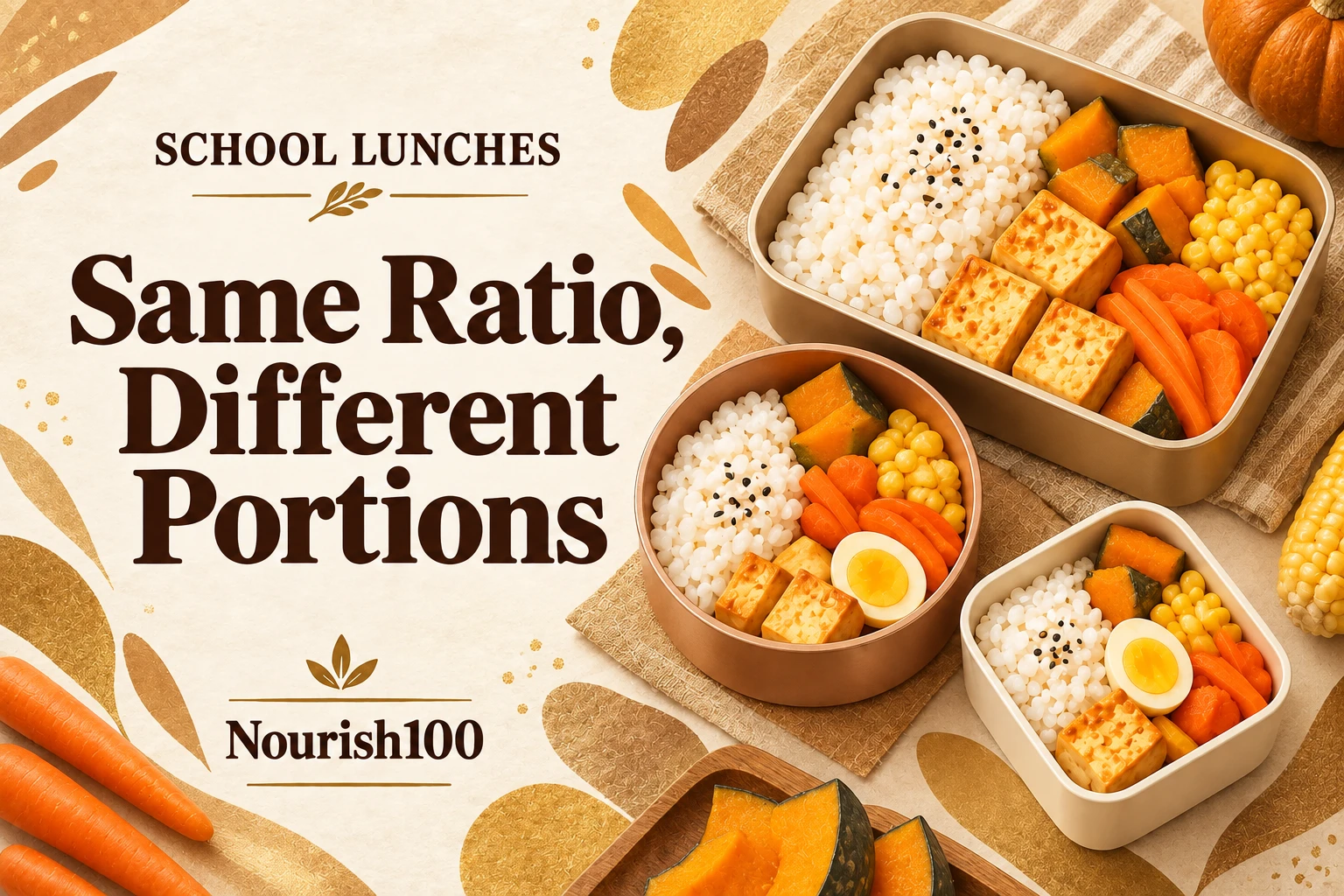
Imagine dividing a suitably sized lunch box into six roughly equal parts: three for grains, two for vegetables, and one for meat, fish, eggs or suitable alternatives. This is the volume-based approach in the Department of Health's training material. It does not ask parents to measure every dish with a ruler, or require two mouthfuls of vegetables after every three mouthfuls of rice.
Two lunch boxes with similar proportions can contain different amounts of food. A smaller box for a lower primary student and a larger box for an older student do not provide exactly the same energy simply because both follow the ratio. Equally, arranging a very small amount of food in neat proportions does not make it enough. Department of Health: Healthy Eating at School: Nutrition Workshop
When discussing lunch, start with “Are the main food groups included?” and then ask “Does this amount work for this student?” The least rice, the thinnest slice of meat or the smallest finished lunch box should not become a healthy-eating competition.
Why not use the same lunch box for every school stage?
The Department of Health nutrition workshop's section on the 2025 lunch revision shows a portion table for lower and upper primary pupils. It is not a secondary-school portion table and should not be applied directly to secondary students. This article does not reproduce its figures as a personal meal plan. The communication ideas below are our practical suggestions by school stage, not an official age-based prescription; actual diets still need to account for age, activity and individual needs. Department of Health: Healthy Eating at School: Nutrition Workshop
For families with lower primary children, a useful first check is whether the child can recognise their food, open the box and has enough time to eat. If a lunch box frequently comes home untouched, ask about practical difficulties and the eating environment before assuming deliberate fussiness.
By upper primary, children can help choose dishes and describe their experience: which food is too dry or difficult to chew, or when they are still hungry afterwards. Secondary students may have more choices from the tuck shop, takeaway outlets or meals out with friends. The discussion can shift to filling a gap in the available food groups, rather than simply checking whether they have “eaten properly”.
These are communication suggestions based on developing skills. They do not mean that every child of the same age must have the same appetite. Nor should gender stereotypes be used to insist that some students must eat more or less.
Making sense of familiar Hong Kong lunches
The three groups are relatively easy to identify in a meal of plain rice, blanched vegetables and steamed chicken. With spaghetti bolognese, fried rice or noodle soup, the ingredients are mixed together, so it may be less obvious whether there are enough vegetables and protein foods. There is no need for every spoonful to match the ratio; first look at what the meal actually contains.
For example, a few chopped spring onions in noodle soup do not make a full vegetable component just because something green is visible. If extra vegetables are available on the menu, consider them as an option. If the school provides a fixed meal, parents and students can give the person responsible for lunches a specific observation, rather than simply saying, “The lunch is unhealthy.”
Grains are not limited to plain rice: noodles, rice vermicelli or other suitable staples can work with different dishes. WHO notes that a healthy diet involves adequacy, balance, moderation and diversity, while its composition varies with age, activity and cultural eating habits. There is no need to exclude all familiar foods in pursuit of a “perfect lunch box”. WHO: Healthy diet
A smaller section for meat does not mean leaving out protein
“One part for meat, fish, eggs and alternatives” can be misunderstood as meaning that protein is unimportant. The ratio simply helps organise different food groups. It does not encourage a lunch of only grains and vegetables, or a meal without suitable protein sources for a growing student.
If a student does not eat a particular meat, parents and meal providers can discuss suitable alternatives rather than simply removing it. Vegetarian choices, religious dietary requirements and allergies are different considerations. “Replace it with tofu” is not a solution that suits everyone; alternatives also need checking when a student has a relevant food allergy.
Similarly, fruit and drinks should not be swapped freely just to make a lunch box look attractive. The workshop encourages schools to provide whole fruit rather than routinely replacing it with fruit juice. Parents can ask whether fruit is offered at recess, lunchtime or another time, instead of assuming that the school provides none because it is not inside the lunch box. Department of Health: Healthy Eating at School: Nutrition Workshop
Observe the eating experience, not body shape
If a child often leaves food, note which food group is left, roughly how much, and whether they were rushed or felt unwell that day. Being hungry after lunch can also be reported calmly. These details help a discussion about meals. Comments such as “You are too fat to eat that” or “You are so thin, you must not be eating enough” cannot replace an understanding of what is happening.
Parents can try a brief conversation a few times a week rather than questioning a child every day: “Was lunch comfortable to eat? What would you like to change? Was it enough?” There is no need to upload photographs for a class ranking, or link the amount eaten with marks, discipline or self-control.
Persistent eating difficulties, noticeable discomfort or concerns about growth and development should be assessed by an appropriate healthcare professional. The lunch-box ratio can support everyday choices, but a lunch photograph cannot diagnose inadequate nutrition.
Next step: discuss one real menu
This week, choose a lunch your child will actually eat. Identify the grains, vegetables and protein foods, then check the total portion, fruit arrangements and time available for eating. If something needs improving, start with one clear issue, such as adding a vegetable option the student can eat, or giving the meal provider feedback on portions.
The aim is not an identical standard lunch box every day. It is an adequate, acceptable lunch with a suitable variety of foods. The ratio is a starting point; the student's actual needs and the food available determine how the discussion can work in practice.
Frequently asked questions
Does 3:2:1 refer to weight or calories?
In this training material, it refers to the relative volume of food groups in the lunch box, not grams or calories.
If a child is still hungry afterwards, does that mean they have eaten too much?
You cannot draw that conclusion. Consider portions, growth, activity and the eating situation that day, then discuss them with the family and meal provider. Do not blame a child for feeling hungry.
Do we need a lunch box with six compartments?
No. Six equal parts are simply a way to understand the ratio. An ordinary lunch box or plated meal can use the same approach. Ease of use and food-safety needs also matter.
Sources
- Hong Kong Department of Health: Nutritional Guidelines on Lunch for Students
- World Health Organization: Healthy diet
Health boundary
This article provides general education. The 3:2:1 model is a practical meal-box proportion, not a fixed prescription for every student. Persistent poor appetite, swallowing difficulty, recurrent discomfort after eating, or an unexpected change in weight or growth pattern warrants individual assessment by a doctor or registered dietitian; do not judge needs from classmates’ portions or body shape.
Evidence and sources
References
- Healthy Eating at School: Nutrition Workshop — 香港衞生署「健康飲食在校園」 / EatSmart@school.hk
- Healthy diet — 世界衞生組織 / World Health Organization
An update may change wording or layout and does not mean every source has been re-reviewed. Guidance may change with new evidence. Check each original source’s date and intended population. Ask a qualified professional about your individual health circumstances.