Nutrition Label Maths: Compare per 100 g, per Serving and per Pack Fairly
One snack label gives figures per 100 g; another gives them per serving. Does the smaller number always mean less sugar? Two clearly fictional teaching labels show how to calculate sugar and sodium per serving, per pack and at the same weight—and why a labelled serving is not an eating instruction for every student.
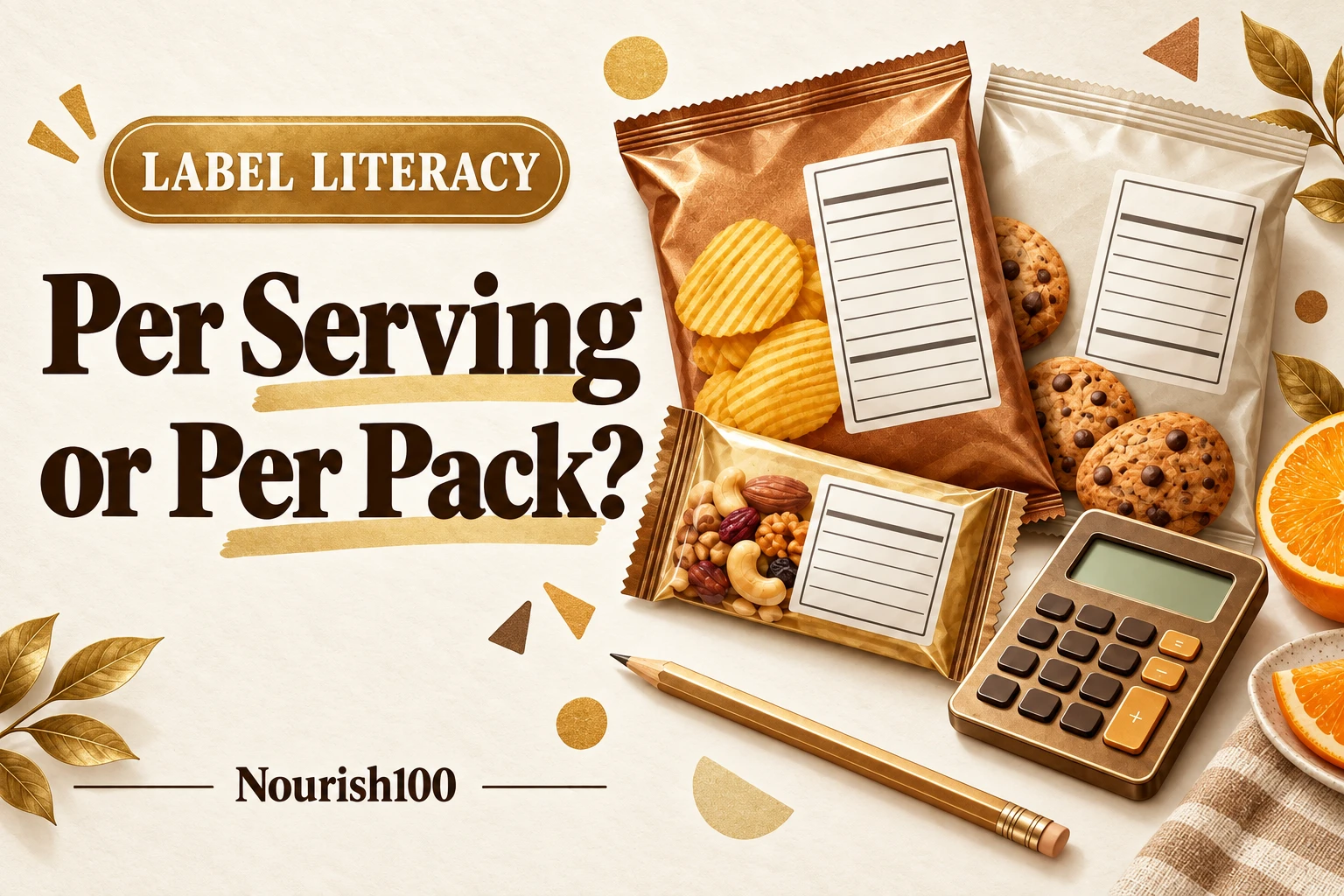
Pick up two packs of snacks in a convenience store: one says 12 g of sugar, while the other says only 2 g. It is tempting to choose the second. But if the first figure is “per 100 g” and the second is “per 20 g serving”, the numbers are not on the same footing.
Reading a label is not just about finding the smallest number. First ask: how much food does this number refer to? The two fictional examples below separate comparing products from estimating how much you have eaten.
This is a maths and label-reading exercise for students and parents, for general education only. It does not provide a diagnosis, an individual weight-loss plan or a prescribed daily intake. All products, pack weights and nutrition figures in the examples are fictional and unrelated to any real brand.
To focus on calculations, the two teaching labels show only sugar and sodium. They are not complete statutory nutrition labels and must not be used directly on commercial packaging. When shopping, read the full information, ingredients, allergen notices and instructions for use. Anyone with individual health needs should follow advice from their healthcare professional.
First, identify the question the label answers
The Centre for Food Safety explains that nutrition information can be given per 100 g or ml, per serving or per pack. Using the same reference amount makes differences between products easier to compare. Serving sizes are set by manufacturers and can differ between products. Centre for Food Safety: Nutrition Labelling FAQ, questions 11–12
“Per 100 g” therefore helps compare the same weight of food; “per serving” helps calculate intake from the number of servings eaten; and “per pack” refers to the whole pack. They do not contradict each other: they use different denominators.
Hong Kong's familiar “1+7” label covers energy and seven specified nutrients, not just sugar and sodium. If this is new to you, start with our introduction to the 1+7 nutrition label (Chinese). Centre for Food Safety: Food Labelling and Nutrition Labelling
Fictional teaching label A: figures per 100 g
Suppose A is a pack of cereal crisps with a net weight of 60 g, a stated serving size of 30 g and two servings per pack.
| A: fictional teaching extract | Per 100 g |
|---|---|
| Sugar | 12 g |
| Sodium | 300 mg |
For one 30 g serving, first work out what fraction of 100 g you are eating: 30 divided by 100 is 0.3. Multiply the label figures by 0.3 to find the amounts in that serving.
Sugar is 12 × 0.3 = 3.6 g; sodium is 300 × 0.3 = 90 mg. If you eat the whole 60 g pack, it contains 7.2 g of sugar and 180 mg of sodium: the per-serving figures multiplied by two servings.
Here, “one serving” is a unit for calculation. It does not mean every student should eat 30 g, or that eating more than one serving is doing something wrong.
Fictional teaching label B: figures per serving
B is also a fictional pack of cereal crisps, but it weighs 80 g, with 20 g per serving and four servings per pack.
| B: fictional teaching extract | Per 20 g serving |
|---|---|
| Sugar | 2 g |
| Sodium | 50 mg |
For the whole pack, sugar is 2 g × 4 servings = 8 g; sodium is 50 mg × 4 servings = 200 mg. A single pack does not necessarily contain a single serving.
To compare B with A at the same weight, convert B to figures per 100 g. Since 100 divided by 20 is five, sugar is 2 g × 5 = 10 g and sodium is 50 mg × 5 = 250 mg.
Multiplying by five simply puts the information on the same basis. It is not a suggestion to eat five servings at once, nor does it mean this pack actually contains 100 g of food.
Why can the same information produce different answers?
Per 100 g, B has lower figures for both sugar and sodium than A. But if you eat one whole pack of each, the larger pack B contains 8 g of sugar and 200 mg of sodium—more than the 7.2 g and 180 mg in the whole pack A.
Both answers are correct because they answer different questions. One asks, “Which has less at the same weight?” The other asks, “How much would I get from eating the whole pack?” Keeping them separate prevents an apparent contradiction.
You also cannot conclude that B is “healthier overall”. This exercise does not compare other nutrients, ingredients, allergy needs, price or the overall diet. A food choice should not depend on a single row of numbers.
Three common calculation traps
First, forgetting the units. Sugar is commonly shown in grams and sodium in milligrams, so you cannot directly compare the size of their numbers. Write the unit at each step: it is easier to spot mistakes than when copying answers alone.
Second, overlooking the number of servings in a pack. If a pack contains four servings, eating two means doubling the per-serving figures, not multiplying them by four. If you have shared some of the pack, its full contents are not the amount you personally ate.
Third, calculating before reading the headings and instructions for use. Check the food weight, portion and units the figures refer to. If the information is unclear, do not directly multiply or compare different columns; ask the manufacturer for clarification.
When drinks are labelled in millilitres, compare them with information on the same millilitre basis. Do not assume that one gram of every food equals one millilitre. When information is unclear, pausing to ask is better than forcing an answer.
Hong Kong shopping situations and your next step
In a supermarket or convenience store, choose similar types of food first, then align the reference amounts. If time is short, find the “serving size” and “servings per pack” so you at least know how much food the figures refer to, rather than relying on promotional wording on the front.
At home, try an exercise that requires no new purchase. Ask a family member to find two complete labels already in the house. One person sets a question; the other explains the calculation. Then swap and check. The goal is to explain the reasoning, not to be the fastest at arithmetic.
If packaging says “low sugar” or “sugar free”, see how to read low-sugar and sugar-free claims (Chinese). A claim cannot replace the complete label, and every eating occasion does not have to become a test.
Frequently asked questions
1. Can I directly compare the per-serving figures on two foods?
First check whether the servings weigh the same. If A has a 30 g serving and B has a 20 g serving, a direct comparison mixes up differences in portion size with differences in the food. Convert to the same weight first, then consider how much you actually eat.
2. Is one serving on the pack the amount I should eat?
It is not an individual prescription. A serving is the reference amount used on the label. Individual needs also depend on age, activity and other eating arrangements. Ask a healthcare professional if you have specific health needs.
3. Do I have to calculate every meal?
No. This is a tool for understanding packaging, not a requirement for students to track every mouthful. If calculating makes you anxious or guilty, or makes you want to keep reducing how much you eat, pause and ask a trusted adult for support.
Sources
- Hong Kong Centre for Food Safety: Nutrition Labelling FAQ for general public
- Hong Kong Centre for Food Safety: Food Labelling and Nutrition Labelling
Health boundary
This is a label-reading and maths exercise, not a personalised diet prescription. People managing diabetes, kidney disease, food allergy or another condition should follow advice from their doctor or registered dietitian. If calculations trigger anxiety, guilt or repeated restriction, stop the exercise and seek support from a trusted adult or qualified professional.
Evidence and sources
References
- Nutrition Labelling: Frequently Asked Questions — 香港食物安全中心 / Centre for Food Safety
- Food Labelling and Nutrition Labelling — 香港食物安全中心 / Centre for Food Safety
An update may change wording or layout and does not mean every source has been re-reviewed. Guidance may change with new evidence. Check each original source’s date and intended population. Ask a qualified professional about your individual health circumstances.