A Water Bottle Is Only the Start: Making Time to Drink at School
Telling children to drink water is easy. Having time to reach their bottle and knowing where to refill it can be harder. This guide turns school-day routines into practical opportunities to drink, explains why juice is not the same as water, and avoids setting one fixed fluid target for every student.
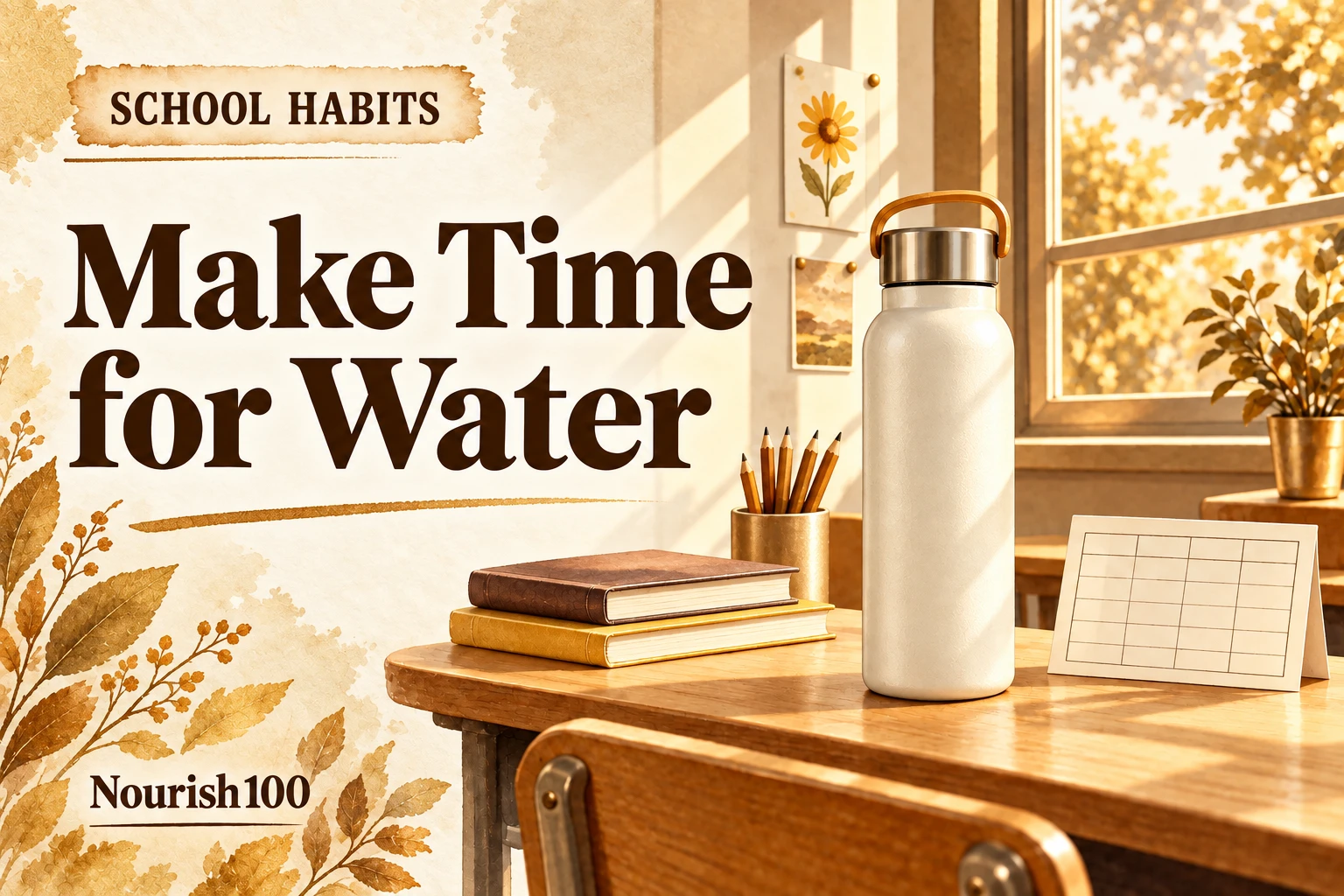
Start by making water easy to reach and giving it a place in the school day. Checking whether a bottle is empty after school is not enough. Students differ in age, activity and health, so this guide does not set one number of millilitres or bottles for every child.
It offers everyday habit suggestions for primary and secondary students, parents and teachers. Students who need to restrict or adjust fluids for medical reasons should follow their healthcare team's advice. Individual fluid-replacement plans for sports training or illness need more than this general guide.
Find out what makes drinking difficult
An untouched bottle does not necessarily mean a child is being uncooperative. The lid may be too tight, the bottle may be buried in a bag, or the student may not know where to refill it. Recess may be taken up by the toilet queue and meeting friends. Try asking, “Was anything inconvenient when you wanted a drink today?”
For younger primary students, practise opening, closing, lifting and packing the bottle at home. Check that the child can manage it independently. Bigger is not always more useful: a heavy, awkward or leaking bottle can become a burden. This is a practical design suggestion, not a reason to buy a particular product.
Older primary and secondary students can choose a carrying arrangement that works for them. They still need to know where refills are available, how to ask for water during class and whether activity days have different arrangements. Ask the school rather than guessing its rules.
Use routines as reminders, not drinking competitions
The Department of Health's EatSmart@school.hk guidance recommends regular fluid replacement and identifies water as a convenient everyday choice. A practical way to apply this is to use transitions already in the day: before leaving home, on arrival, at recess or lunch, or after an activity. These can be opportunities to check whether a drink is needed. EatSmart@school.hk: Interesting Tips
They are reminders, not orders to finish a glass each time. Students should not gulp large amounts to complete a checklist or lose marks for forgetting once. The aim is access, the ability to express a need, and a reminder that gradually becomes their own.
Teachers might use a simple verbal prompt or provide a suitable moment to organise bottles. Avoid public comparisons of who drinks most. A race based on speed or volume turns an everyday need into another performance test.
Make plain water the everyday starting point
If a child prefers flavoured drinks, there is no need to replace water immediately with cartons of juice or other drinks. First look at access and routine: a manageable bottle, water within reach and family members modelling everyday water drinking. Change one thing at a time rather than repeatedly scolding.
EatSmart also advises against using sports drinks instead of water every day. A sporty label alone does not make a drink more appropriate for a normal school day. Prolonged or unusual exercise needs advice suited to the activity. EatSmart@school.hk: Interesting Tips
Avoid describing drinks as choices for “good” or “bad” students. A more useful message is, “Water is our usual choice; for other drinks, we look at what they contain and the occasion.” This supports learning without food-related shame or secrecy.
No-added-sugar juice is not the same as water
“No added sugar” does not mean sugar-free. WHO notes that most fruit juice still contains significant free sugars. Sugars in honey, syrups and fruit juice do not cease to count because they are naturally present. WHO: Healthy diet
Water and juice therefore have different roles in an everyday drinking routine. Having juice once is not a moral failure; the practical point is not to replace every opportunity to drink water with juice.
Pictures of fruit, vitamin claims and descriptions such as “refreshing” do not replace a label check. Older students can practise finding figures per 100 ml and then checking the whole pack's volume. Use the same reference quantity when comparing products, rather than comparing a small serving with a large pack. Centre for Food Safety: Food Labelling and Nutrition Labelling
Share the practical jobs
Students can remember their bottle, learn the refill locations and speak up about difficulties. Parents can provide clean, suitable equipment and ask neutral questions about the day. Teachers can explain when and how drinking fits around lessons and activities.
For an outdoor learning day, “bring a bottle” may not tell families enough. An activity notice could explain whether refills are available and whether extra preparation is needed. This is a communication suggestion; each school decides the arrangements for its activities.
Do not diagnose a problem from the amount left after school. A student may have refilled the bottle or had other drinks or fluid-containing foods. The bottle is a clue about routines, not a diagnostic instrument. Persistent discomfort or concerns about fluids and health call for professional advice, not an automatic instruction to drink more.
Next step: observe opportunities for one week
Instead of recording millilitres, notice three things: whether the bottle is easy to reach, which moments allow a drink, and where the routine most often breaks down. A brief private conversation each day is enough; no public tracker is needed.
At the weekend, choose one adjustment together. It might be a more accessible pocket, learning the refill point, or checking the bottle while packing away lunch. See whether the next week is easier. A sustainable habit often depends on making the action convenient, not making the target stricter.
Frequently asked questions
Must every primary student drink the same number of bottles each day?
No. Bottle sizes and individual circumstances differ. Students with particular health needs should follow individual advice rather than a shared bottle target.
If my child dislikes water, must I switch to a sugar-free drink?
Not necessarily. Start with access, reminders and understanding the reason for the dislike. A “sugar-free” label does not make every product suitable for every student.
Does water left after school prove that my child has not drunk enough?
No. Ask about refills, obstacles and the day's activities. Do not diagnose from one observation or insist that the child force down the remainder.
This article is for general health education only. It does not replace diagnosis, medication adjustments or personalised treatment. If you have symptoms, a long-term condition, are pregnant, take medication or have questions about changing your diet, consult a qualified medical or nutrition professional.
Sources
- Hong Kong Department of Health EatSmart@school.hk: Interesting Tips
- World Health Organization: Healthy diet
- Hong Kong Centre for Food Safety: Food Labelling and Nutrition Labelling
Health boundary
This article provides general education and does not set one fluid target for every student. Fever, persistent vomiting or diarrhoea, markedly reduced urination, unusual drowsiness or altered awareness need prompt clinical assessment. Students with kidney or heart disease, or a prescribed fluid restriction, should follow their own clinical plan rather than increasing or reducing fluids independently.
Evidence and sources
References
- Interesting Tips — 香港衞生署「健康飲食在校園」 / EatSmart@school.hk
- Healthy diet — 世界衞生組織 / World Health Organization
- Food Labelling and Nutrition Labelling — 香港食物安全中心 / Centre for Food Safety
An update may change wording or layout and does not mean every source has been re-reviewed. Guidance may change with new evidence. Check each original source’s date and intended population. Ask a qualified professional about your individual health circumstances.